


Our 5th annual State of the Parkway is on November 6th, and this is the first year that we have invited an out-of-state guest. I suspect that our guest is not yet a household name, but some of you are already familiar with the Atlanta Beltline. I'm sure you all are curious about the potential for the Red Line Parkway, and that's a large part of why we want you to know more about the Atlanta Beltline and the comparison to the Parkway.
I’ve been working on making cities more bikeable and walkable since the late 1980s, more so since I joined the board in 2006 of what is now merged to Safe Streets Austin. From growing up in Minneapolis, and moving to Austin in 1999, I’ve witnessed and heard what brings people to bike and walk where they live.
My hometown ranks among the top US cities for biking and walking, in large part, though not exhaustively, because of its well-connected street system (including low-car streets), closeness of destinations (a.k.a. density), access to ubiquitous and reliable public transit, and its wide-reaching paved trails system, the core of which was built in the early 1970s. Its sister city of St. Paul and many of the suburbs share these attributes.
On the other hand, Austin has some of these assets, but only in pockets of our city. Our city’s paved trails system has very limited reach. Though our system is growing, it is generally disconnected, and existing trails are generally away from our city’s population and economic centers. Where our city’s trails do serve population centers, they see tremendous usage, e.g. The Butler Trail and the trails that connect to it (e.g. Shoal Creek Trail) sees over 5000 daily users at its most popular points. The Walnut Creek Trail (Northern and Southern), and portions of the Red Line Parkway system, e.g. Boggy Creek Greenbelt Trail and Crosstown Bikeway, are catching up to that. (Astute readers will note that some of these trails are not fully paved, but nevertheless they are well-maintained to support daily usage.) Our regional neighbors to the north, also see high usage, e.g. Brushy Creek Regional Trail and Pflugerville trails.
The Red Line Parkway would connect many of the densest areas of our region with a trail system virtually free of conflicts with car traffic, and generally away from the noise and air pollution and traffic dangers of any street. It would provide many more people what those in Downtown Austin and nearby neighborhoods have—a place to recreate and travel in their city without the stress and burden of motor vehicle traffic.
I think most/all people reading this find this exciting…, but why invite the CEO of Atlanta Beltline, Inc.?
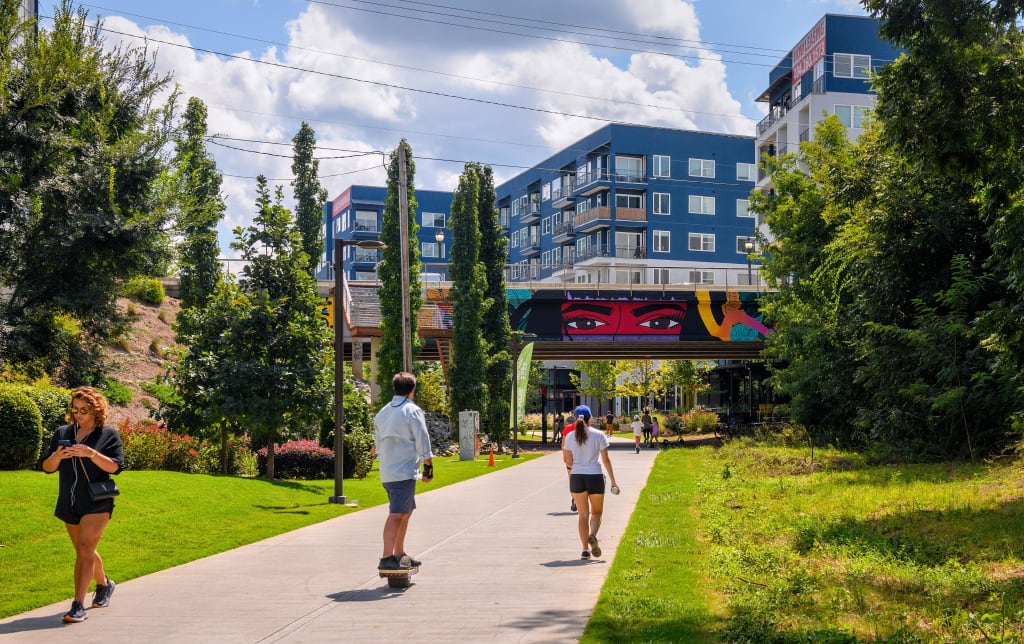
Only a handful of trail systems around the country have taken the potential of urban trails to the next level. This includes creating the space for people to center their daily lives around their trail system. It includes attracting trailside development—not just new residential development investments, but also attracting massive private investment to create new commercial hubs. In addition, some trails also include robust transit service along the corridor, or plans to do so. The Minneapolis Midtown Greenway and the Atlanta Beltline are among the few examples to do all of these well, and our region can learn from them.
The Atlanta Beltline has become among the city’s most cherished assets and on most top 10 Atlanta places to visit. It’s “a 22-mile loop of parks, trails, and transit, connecting 45 neighborhoods and creating a vibrant public space for recreation, commerce, and cultural expression in Atlanta.” Ponce City Market and nearby developments along the Atlanta Beltline Eastside Trail are oriented toward the trail, because that’s where people want to be. As one Austin colleague said, “you can walk into a Kroger [a supermarket chain] from the Beltline.” Indeed, even in Austin we have a few examples of trailside development, e.g. Cosmic Saltillo has one of its two entrances facing the Red Line Parkway, and a dozen businesses and hundreds of residents directly access the Red Line Parkway between Comal and Chicon. But then multiply this by hundreds or thousands of businesses and residences entering onto the trail and you begin to understand the success of the Beltline, and how to help create a city oriented around trails (and transit). As another Austin colleague said about a recent visit to the Beltline, the commercial and dense residential nodes along the Beltline are punctuated by sections that provide much-needed access to nature, parks, and open space within the city.
Though the Atlanta Beltline project was in large part instigated by an urban planner, a nonprofit, and then the City of Atlanta, there’s no question that it’s proven to be wildly popular with both the general public and with private investors. Typical daily traffic in spring/fall at multiple locations on the Beltline is around 10,000 users, comparable to the volume of car traffic on the busiest parts of Austin’s Congress Avenue. The Beltline corridor has helped attract more than $9 billion in private development, from a public delivery cost of about $776 million from 2005-2023. That’s a return-on-investment of over 11:1, and private investment continues to result from the public investment already made. I believe that the Red Line Parkway can be at least as transformative for Austin as the Beltline has been for Atlanta.
This is why we invited the President & CEO of Atlanta Beltline, Inc., Clyde Higgs, to come to Austin to speak—to share more about this success on the Beltline, and for our region to learn what the potential is here. His background is in economic development, and if you have any questions you want to bring into the fireside chat, please reach out to me. He will also discuss how they’ve made progress to complete over half of the Beltline, and share stories about the various other community successes from the Beltline.
Please spread the word about the State of the Parkway. Let’s get a packed house. And if you haven’t already, please invest in the future of the Red Line Parkway by making a donation today. (Can't attend? Tap here to make a donation without registering.)
State of the Parkway sponsors and donors at the Trailblazer level and above and are invited to attend a special reception with Clyde Higgs earlier in the morning on November 6th. Please reach out with any questions.
Tom Wald
Executive Director
Red Line Parkway Initiative
